
In December 2023 we launched our bi-monthly webinar series ‘Inspiring populations’ as a way to start and continue conversations, within and beyond population geography. Building on the 50th Anniversary of the group we want to embrace the collegiality and provide a supportive space for our academic community to share research. The conversational approach means that whilst each webinar is led by the speaker we hope these offer an opportunity to chat about things we might find interesting, connect around topics exciting fellow population geographers, ask and answer any questions, and offer feedback where this is solicited.
These events are open to all, and we encourage ECRs to take part.
These take place online every other month (or there abouts) on Wednesdays between 14:00pm and 15:00pm.
If you would like to join the conversation or indeed have research you would like to share with us in leading the conversation at an upcoming Inspiring Population session, please do get in touch with David.McCollum@st.andrews.ac.uk
Upcoming Inspiring Populations Webinar:
More Info Coming soon.
Previous Inspiring Population Conversations:
3rd September 2025 : Bozena Sojka, Institute for Future Cities at the University of Strathclyde

No Longer There, Not Yet Here: The Liminal Lives of Ukrainian Refugee Youth in the UK
The article explores the lived experiences of young Ukrainian refugees in the UK through the lens of liminality, highlighting the transitional and uncertain nature of their migration and integration process. Beginning with an overview of the Ukrainian refugee crisis and the policies shaping their resettlement, the article examines how these youth navigate their social, educational, and cultural transitions. By applying liminality theory, the article illustrates how refugee youth exist in an ‘in-between’ state (detached from their home country yet not fully integrated into British society) leading to identity struggles, social exclusion, and shifting roles. Through qualitative analysis, the articles identify key themes such as uncertainty, identity formation, social inclusion/exclusion, and the role of support networks in shaping their experiences. By filling a gap in migration studies, this article offers a nuanced understanding of refugee youth transitions and provide insights for policymakers, educators, and community organisations working to support their integration and well-being.
19th August 2025: Prof. Tialda Haartsen, University of Groningen
A conversation hosted by the James Hutton Institute, Aberdeen.

Leaving for good or coming back? Identifying long-term internal migration patterns of rural young adults in the Netherlands
To counteract the effects of young adult out-migration on rural areas, there is increased interest in those who return and why. Yet relatively little is known about the migration patterns that unfold after leaving. This paper aims to identify the migration trajectories of rural young adults (aged 11-35 years) using the System of Social Statistical Datasets of Statistics Netherlands. Sequence and cluster analyses of the migration behaviour of rural young adults reveal five clusters of migration patterns, labelled as (1) return migrants, (2) repeat leavers, (3) late leavers (4) onward migrants, (5) one-time migrants, in addition to a group of non-migrants: (6) stayers. We document which life course trajectories are associated with the identified clusters. We find that return migration is more likely when individuals partner with someone from the same area of origin, while having a partner from other areas is linked to continued migration. Men are more likely to be in the clusters of late leavers and stayers. Furthermore, education level, field of study, and parenthood also show clear associations with specific rural migration patterns.
7th May 2025: Ellen Hjort, Aberystwyth University,

The happy(?) object of rural community and the longing for youth
The worries and challenges around demographics, specifically regarding the aging populations of many European ruralities, are often seen as natural. Explanations include the need to offset costs of care and pensions with tax income from working people. However, this argument is not only used in relation to places and regions that are in control or directly paying for healthcare or services. Based on two rural case studies, the Llanidloes area in Mid Wales and Åsele in Northern Sweden, this presentation attempts to theorise the focus on youth and sometimes disregard for what elderly people bring to rural communities. Drawing on Sara Ahmed’s work on the promise of happiness and how this is premised upon orientation towards ‘happy objects’, ‘community’ can be understood as a happy object. Belonging within a place or community is continuously produced in the tension between longing and belonging, future and present, and comparisons between place, trajectory and future hopes. If ‘community’ is seen as a happy object, it needs to be continuously reproduced, both in the present and into the future. Some residents work hard to orientate themselves towards community. Building community can be an uphill struggle to maintain services, sometimes also in opposition to broader narratives of the promises of urbanity rather than rurality. For these individuals, happiness might not be achieved now, but could be assured for the future. However, this requires future generations to eventually replace the old. Young people thus become symbols of the promised future and payoff for the work that goes into producing community.
4th December 2024: Sen Li, University of St Andrews
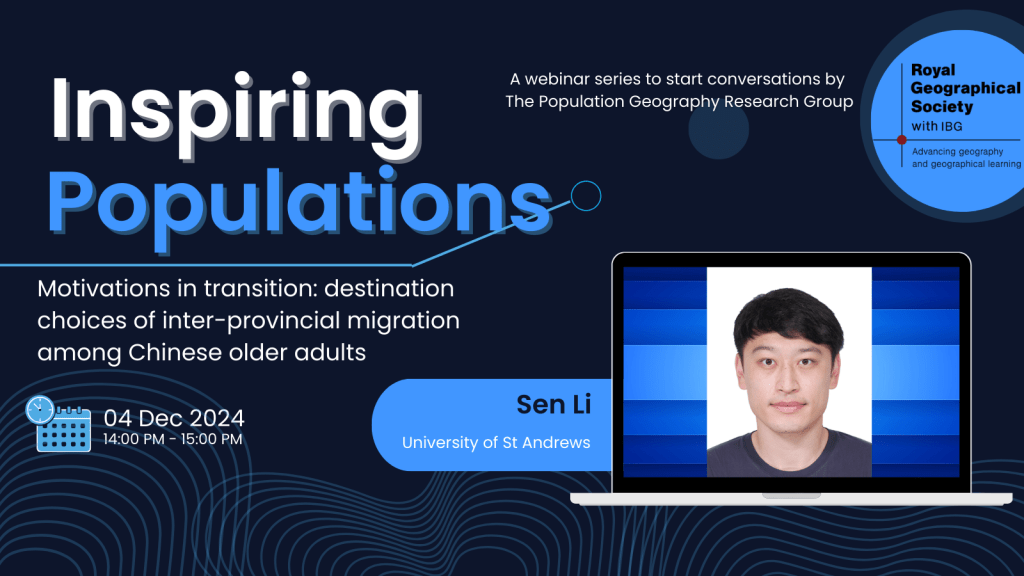
Motivations in transition: destination choices of inter-provincial migration among Chinese older adults.
Abstract :
Despite the growing interest in the migration of older adults in China, the intricacies linking migration motivations with destination choices remain insufficiently explored. Drawing from China’s unique context, we categorize inter-provincial older migrants into three types: employment-led, dependent, and lifestyle. Using microdata from the Sixth Population Census of 2010 and the 1% Population Sampling Survey of 2015, we examine their evolving motivations and corresponding shifts in destination preferences. The analysis shows an increase in lifestyle-oriented migration and a decrease in dependent migration, while employment-led migration has remained stable relative to the total. Older migrants seeking employment tend to favour destinations further south, prioritizing regional economic conditions. In contrast, those motivated by lifestyle factors exhibit a broader range of destination choices, largely due to their preference for amenities. Dependent older adult migrants consider both job-related and amenity-related factors and demonstrate a stronger tendency to relocate to the east. Amenity-related factors have increasingly influenced the destination choices across all three types of migration over time. Our findings provide deeper insights into the intricacies of migration in old adulthood and highlight the need for tailored policymaking.
2nd October 2024: Mary Abed Al Ahad

Homeownership Across Immigrant Groups and Generations in Sweden: Assimilation or Segmentation?
Abstract:
Homeownership is an important indicator of immigrant integration. Using large administrative individual-level longitudinal data from Sweden between 1997 and 2016, we investigated entry into homeownership across immigrant groups and generations. We differentiated between immigrants arriving as adults (1G) and children (1.5G) and between descendants of immigrants with two (2G) and one (2.5G) foreign-born parent(s). We considered immigrants from both high and low- to middle-income countries. Immigrants from sub-Saharan Africa showed the lowest propensity to move to homeownership, whereas immigrants from Nordic countries, Western Europe and North America had the highest propensities. A very large proportion of immigrants, especially those from Nordic countries and Western Europe moved to first-time homeownership already in their first year in Sweden. In general, we observe a clear gradient across immigrant generations: the 2.5G has homeownership levels closer to native Swedes than the other generations. However, the 2G, especially from low-income countries, show slightly lower entry levels to homeownership than the 1.5G. Overall, our results support gradual housing assimilation and integration across migrant generations, but also highlight the special circumstances during migrants’ first year in Sweden and the importance of financial resources, the reason of immigration, and the socio-cultural background for housing careers.
Recording can be viewed here: https://youtu.be/uSeZMzTWoNw
29th May 2024: Suzanne Beech

New’ Irish Borderlands? Reflecting on Young People’s Perspectives on Citizenship and Identity Following Brexit
- Suzanne Beech: Lecturer in Human Geography, Ulster University – s.beech@ulster.ac.uk
- Sara McDowell: Senior Lecturer of Human Geography, Ulster University – sp.mcdowell@ulster.ac.uk
- Mark Holton: Associate Professor of Human Geography, University of Plymouth – mark.holton@pymouth.ac.uk
- Amy Reid: PDRA, Ulster University – a.reid2@ulster.ac.uk
Since the Partition of Ireland in 1921 the Irish Border has been a place of contestation where change needs to be handled sensitively. However, the Brexit Referendum of 2016 has threatened to undo much of the progress made since the signing of the Good Friday Agreement in 1998. The eight years since have been punctuated by opposition to new arrangements and borders, and a prolonged period of political instability – five of those years were spent without a functioning local government. This Inspiring Populations session will offer reflections from an AHRC project considering how young people (aged 16 to 24), and who were both unable to vote at the time of the Referendum, and part of the Post-Good Friday Agreement generation, view these frictions and developments. It uses data collected from a filmmaking exercise and interviews to investigate how recent years have changed their understanding of who they are and how they feel about the Irish Border, and any new borders which they have experienced as a result of the Referendum. In so doing it offers insights into how their mobilities are influenced by the Border, the impact of this on their citizenships and identities, and reflections on the future of the Irish Border in the years to come.
Recording can be viewed here: https://youtu.be/-73kZK-U0rk
20th March 2024: David McCollum

The second in the Inspiring Populations webinar series took place on Wednesday 20th March when current PopGRG chair Dr David McCollum, University of St Andrews, led the conversation with a short presentation about his recent research into the geographies of working from home (WFH). The talk explores the potential for WFH to ‘level up’ spatial inequalities in the UK and is entitled: ‘ Post-pandemic geographies of work-home relations: Plus ça changefor spatial inequalities?”
View the video here : https://youtu.be/o7PFlVJpZZs
6th December 2023: Odhran Fox

Our first ‘Inspiring Populations’ conversation was held on Wednesday 6th December. Our ECR Officer Odhran Fox led the conversation with a short presentation about his PhD research to date entitled “International student mobility options following Brexit: An analysis of the genesis of Britian’s Turing Scheme”.
This conversation covered some of our work on post-Brexit decision-making. With a core focus on schemes that endeavour to enable and encourage outbound international credit mobility for UK-domiciled students. We will draw on reflections from our paper, recently published in Population, Space and Place which investigates how UK decision-makers developed a domestic credit mobility scheme – the Turing Scheme – in light of a withdrawal from the highly successful Erasmus+ programme. In this we discussed the impact of geopolitical change on political agendas, economic considerations, and the utilitarian needs of students, and how these interact to provide opportunities for ISM in the UK context.
Odhran introduces the core findings from this analysis of Parliamentary debates, and ongoing research to evaluate how these recent changes have impacted mobilities on the institutional scale, exploring some of the key themes identified in the paper and how these relate to evaluations from Higher Education staff, in a bid to ask Have the goals proposed by decision-makers which justified the development of the Turing Scheme been met? and to what level of success?
View the video here : https://youtu.be/9RZEqjUqwas
 Population Geography